Table of Contents:
Every other part of your funnel is paid for in salary, tooling, or time. The click is different. The click is the one place where you hand over cash to ad providers, per unit, on a metered basis, and you know the exact price. Which is what makes the next few seconds the most expensive real estate in your marketing campaign.
Most teams have spent years optimizing everything up to that point and almost nothing after it. We’re here to change that.
Run the numbers on your own spend
Take a campaign you are running right now.Let’s say you are paying ~$6 a click, which is unremarkable for a competitive B2B/B2B campaign, and sending that traffic to a landing page.
Landing pages lose roughly 96% of the traffic that reaches them. About 95% bounce, and only around 3% of people complete the form. So of every hundred clicks you buy at $600, three or four turn into anything at all. Your real cost per captured lead is somewhere north of $150, and that is before you account for the ones who filled in a fake email address.
Now notice where the loss is sitting. It’s not in the auction, the audience, or the ad. You won the auction because the person clicked. They were interested enough to leave whatever they were doing and learn more about you. The money evaporates right there, in the gap between the click and the landing page finishing its job.
You cannot A/B test your way past the format
The standard response is conversion rate optimization. Move the button, shorten the form, change the headline, add a testimonial, cut the page load times, etc., etc., etc..
Don’t get us wrong, that work is real (and important) and it does move the needle. It also has a glass ceiling, because it’s optimizing the 4% while the format determines the 96%. A landing page asks a person on a phone to read, scroll, evaluate, and then type. Every one of those steps is optional from the customer's point of view, and the exit is always one gesture away.
The other thing a landing page does is give you almost nothing when it fails. A bounce translates to an anonymous session. You paid $6, learned that someone was interested, but you can’t see who it was, can’t follow up, and can’t count them in any pipeline that is worth anything to you later.
Make the post-click destination a conversation
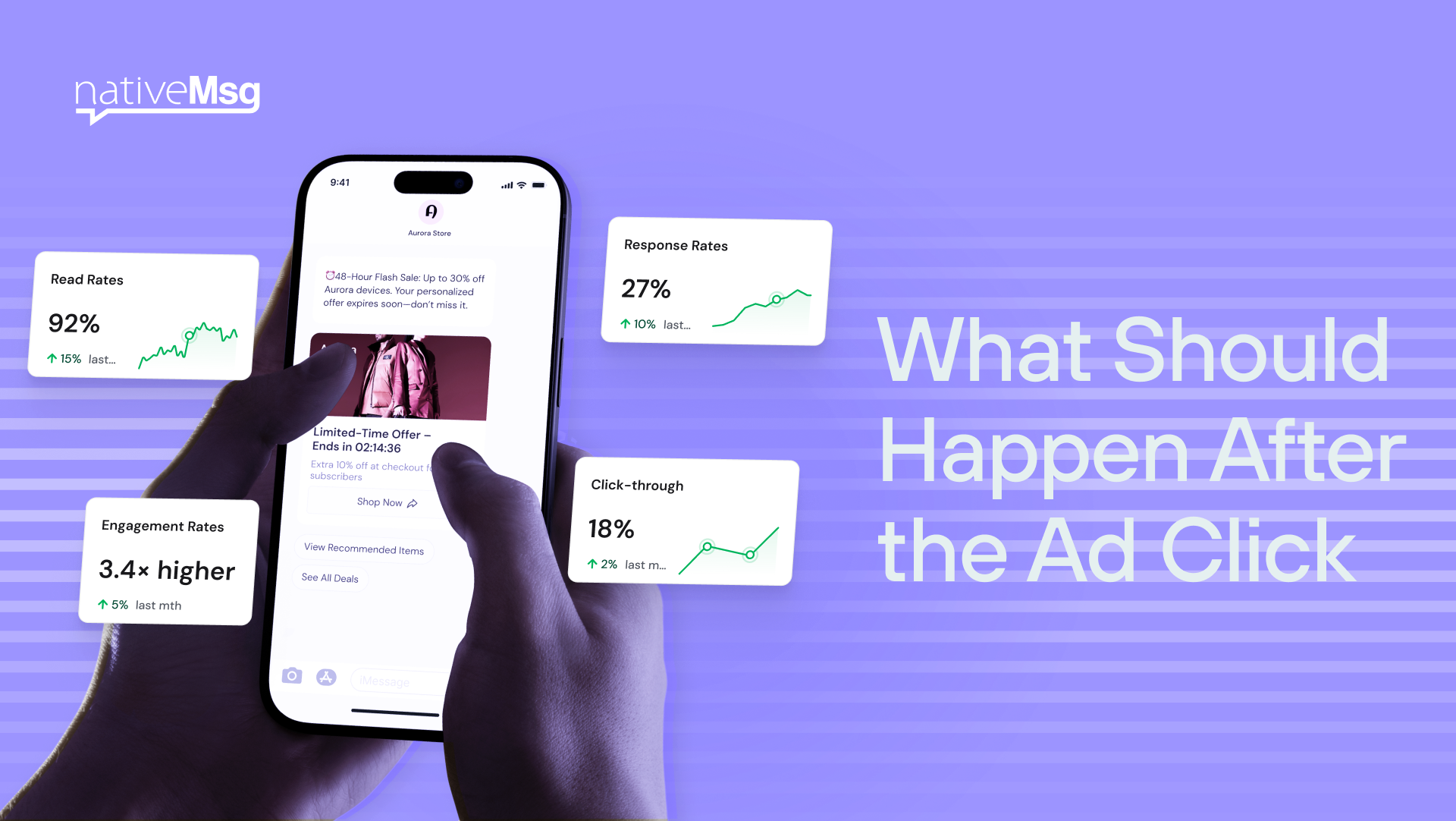
We’ve developed an alternative, and it’s built to have the click open a text message thread rather than a web page. Rich Communication Services, the mobile carrier standard that has replaced SMS on modern devices, lets a paid click land in the customer's own messaging app with a company branded conversation.
What changes in that first interaction:
- The ask gets smaller. Instead of a form, they get one tappable question (ie. “How was your experience? Give us 1-5 stars” with buttons to tap quickly). Which product, which problem, which store, which date. A tap costs the customer a second and no keyboard inputs, so they’re way more likely to do it.
- The brand is verified upon arrival. Your company name and logo sit at the top of the thread just like their actual contacts do, and the sender is spoof-protected, so the person who just clicked an ad knows exactly who they are now talking to and that they’re in the right place.
- The answer can be shown, not linked. Single product images or full image carousels (up to 10 per message), a video, a PDF, audio, the list goes on. The thing they clicked to see arrives in the thread.
- The conversation completes the action. Book, buy, join, check availability, get quoted, reorder.
- The thread persists. When the session ends, the conversation stays in the customer's messages with your name on it so they can come back to it at any time. That is the part a page can never do.
Google Ads supports click-to-message assets natively, so this is not an exotic media buy. Paid social clicks can open the same experience through their in-app browser. The campaign structure you already run stays intact.
The compounding effect on your ad spend
This matters more than the first-touch conversion rate.
Signal loss has been quietly eroding paid media for years. Tracking is more restricted, audiences are harder to rebuild, and platform-side attribution is less trustworthy than it was before. Every quarter, an anonymous click is worth a little less than it was the quarter before. That’s just the nature of the game.
A click that ends in a conversation produces a consented, identified contact with a phone number, that can flow into your CRM in real time. That contact is not subject to a cookie window or a platform policy change. You can reach them again next month without buying the click a second time.
So the best comparison is not conversion rate versus conversion rate, it’s cost per anonymous session versus cost per owned relationship. Once you have the second thing, your retargeting stops being a media line item and starts being a message you send. Let the conversation do the work for you.
Here’s the math to run before you commit anything
You do not need a new campaign to test this. Take one ad group you are already paying for and split the destination:
- Cost per identified contact, page versus conversation, using the same spend. This is the headline comparison and usually the least flattering one for the page.
- Completion rate on whatever the campaign's actual goal is, not the micro-conversion. Form fills are not the goal, booked demos and purchases are.
- Percentage of clicks that produce something reachable. With a page, this is your form-fill rate. With a thread, count every consented contact.
- Return on the same ad spend across 30 days, including revenue from second contacts you did not pay for a second time.
- Cost per acquisition trend, since the persistent thread should bend this down over time in a way a page cannot.
Same budget, same creative, same audience. One variable changed.
The destination is the cheapest thing to fix
Out of everything in a paid media campaigns, the post-click destination is the least examined and also the easiest to change. You are not renegotiating rates, rebuilding audiences, or replacing creative. You’re just changing where the click goes.
In our opinion, you should start small, prove it works, and then scale.
See it on the device it lands on
Don't take our word for it. Tap through it.
The interactive guides walk you through a branded messaging experience exactly as your customer would see it, on the platform they are holding:
Running paid traffic right now? Book a demo and we will take one live ad group, build the conversation its clicks could land in, and set up the cost-per-contact comparison against the page you are using today.