
Table of Contents:
Most revenue leaks can be recovered later, but missed appointments cannot. An empty chair at 2pm on Tuesday is gone by 2:01pm. It’s the most perishable inventory in any service business, and unlike almost every other loss in your operation, you can put an exact dollar figure on each unit.
You probably already know your no-show rate. What is less examined is why the standard fix stopped working. Let’s talk about that.
Everyone already sends reminders
Reminders are not a competitive advantage anymore, they’re standard operating procedure. Your scheduler sends them, your competitor's scheduler sends them, and your customers receive several a week from various businesses and event engagements.
This means the reminder is no longer the constraint, what the customer can do with the reminder is.
Look at what a typical reminder offers → a line of text confirming a time, and possibly an instruction to “reply Y to confirm” or “call the office to change it.” That’s the entire set of available actions. One of them requires the customer to type to respond, and the other requires them to make a phone call during business hours, which is the thing they were trying to avoid when they booked the reservation online in the first place.
So the customer who cannot make it does the path of least resistance, which is nothing at all. Silence is easier than a phone call, and you find out after they don’t show up.
The three things a customer actually wants to do
When a reminder lands, a person is in one of three states, and a useful reminder would let them act on all three with a tap:
- I will be there. Confirm, and take yourself off the follow-up list.
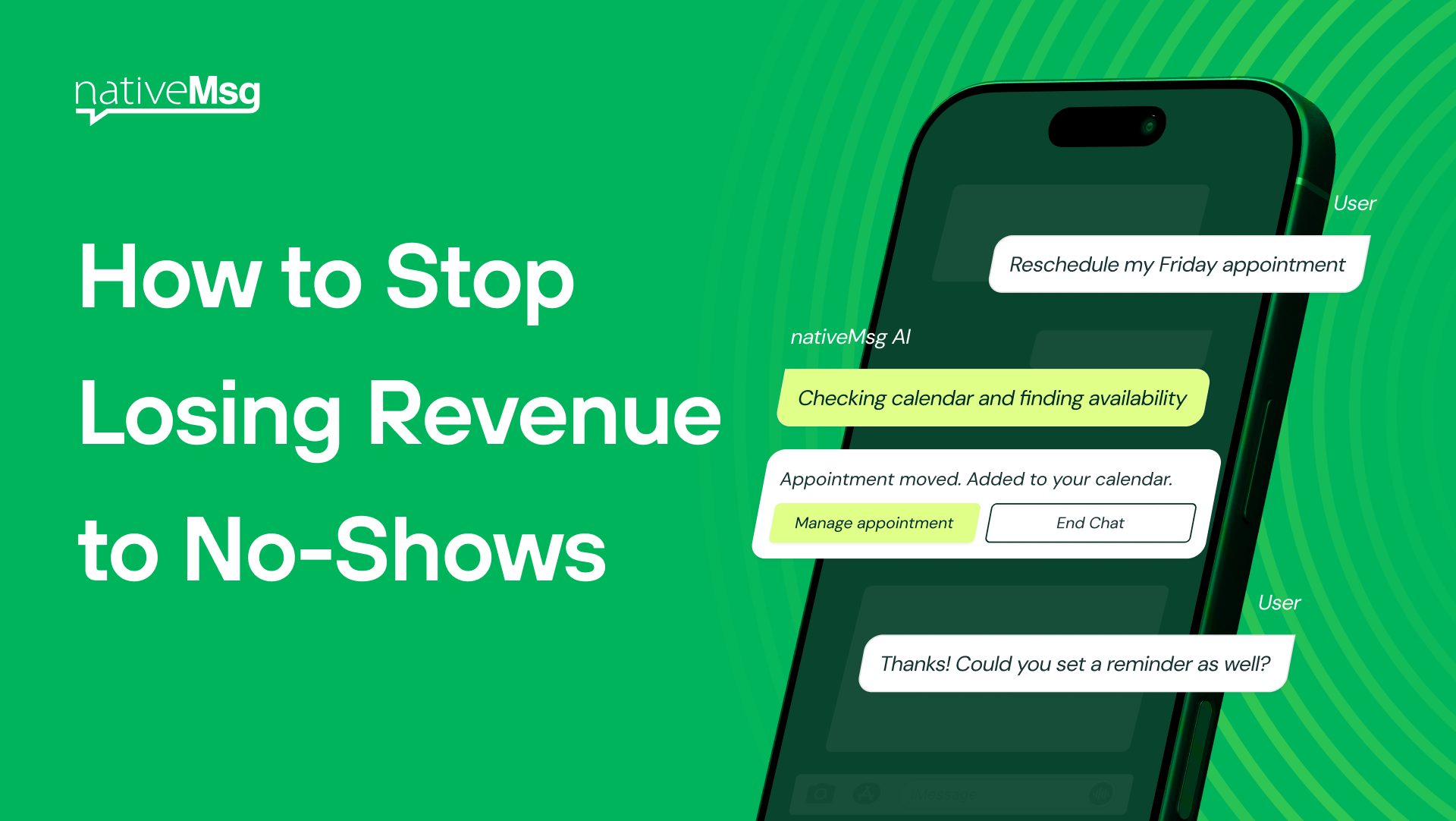
- I cannot make that time, but I still want the appointment. Reschedule, from available slots, in the thread.
- I cannot make it at all. Cancel, honestly, right now.
The third one is where most operators get the incentives backwards. Making cancellation easy feels like inviting cancellations. In practice it is the highest-value option on the list, because an early cancellation is fillable inventory and a no-show is not. A slot released Monday afternoon can be sold.
You are not choosing between a kept appointment and a cancelled one. You are choosing between a cancelled one and a no-show, and a cancellation is an opportunity for regaining revenue.
Close the loop: cancellation should trigger an offer
This is the part that turns a reminder program into a revenue program.
When a customer cancels in the thread, that event can immediately offer the slot to your waitlist. A branded message goes out to the people who wanted an earlier time, with the open slot and a button to claim it. First person who taps yes takes it, the thread confirms it, the scheduler updates it internally, and the chair is full again.
Rich Communication Services, the carrier standard that has replaced SMS on modern devices, is what makes each step a tap rather than a phone call: your logo and verified brand name on the message, buttons for confirm, reschedule and cancel, a list of available times the customer can pick from, and a two-way thread if they have a question first.
The fix is not clever copy. It is removing every reason a customer would default to silence, then routing the released capacity to someone who wants it within minutes.
What this attaches to in your stack
Nothing here requires replacing your scheduling system.
Whatever you book appointments in today already emits the events this depends on: appointment created, appointment approaching, appointment cancelled. If that system can send a webhook, call a REST API, or run an AI agent, it can trigger the branded conversation instead of a plain text. Automatic SMS fallback covers any device that cannot receive the upgraded format, so no customer stops getting reminders during the change.
This applies across appointment-based operations generally: clinical and dental practices, veterinary, auto service, home services, personal care, professional services, and restaurant reservations. The mechanics are identical, only the revenue per available timeslot differs.
The arithmetic, on the back of a napkin
When you get a change, use your own numbers to map this out.
Take your weekly booked appointments, multiply by your no-show rate, and multiply that by your average revenue per slot. That is your weekly loss, and you can annualize it in one more step.
Next, ask a narrower question: what would recovering a third of those be worth? Not all of them, since some no-shows are unreachable by any system. A third is a conservative target for the combination of easier confirmation, in-thread rescheduling, honest early cancellation, and waitlist backfill.
For most operators, that number lands well above the monthly cost of the messaging program, which is why this play is a logical step.
What to measure in the first 30 days
Run the upgraded reminder against your current one on a portion of your bookings:
- No-show rate, the headline number, compared across the two groups.
- Confirmation rate, and specifically how many confirmations came from a tap versus a reply or a call.
- Cancellations received more than 24 hours ahead. Expect this to rise, and read it as a win rather than a problem.
- Waitlist fill rate on released slots, which is where the recovered revenue actually shows up.
- Inbound calls to reschedule, which should fall, freeing front-desk time you are already paying for.
The reminder was never the problem
If you have added reminders, added a second reminder, and added a confirmation request, and your no-show rate has barely moved, more reminders will not fix it. The message is arriving. It just does not let anybody do anything.
Give the customer three taps and give the cancelled slot somewhere to go.
See it on the device it lands on
Don't take our word for it. Tap through it.
The interactive guides walk you through a branded messaging experience exactly as your customer would see it, on the platform they are holding:
Know your no-show rate? Book a demo and we will build the confirm, reschedule and waitlist flow against your scheduling system so you can run it on real bookings.