Table of Contents:
Omnichannel Isn’t Broken, It’s Just Incomplete
Most brands believe they’re running omnichannel campaigns but in reality, many are still operating multichannel programs with better coordination and nicer dashboards.
Your emails go out, your ads retarget, and your push notifications fire away. Each channel performs its role, but the customer journey often feels disjointed, repetitive, and/or out of sync. All of this can be explained because brands are missing a key piece to their channel structure.
RCS for Business messaging is that missing piece.
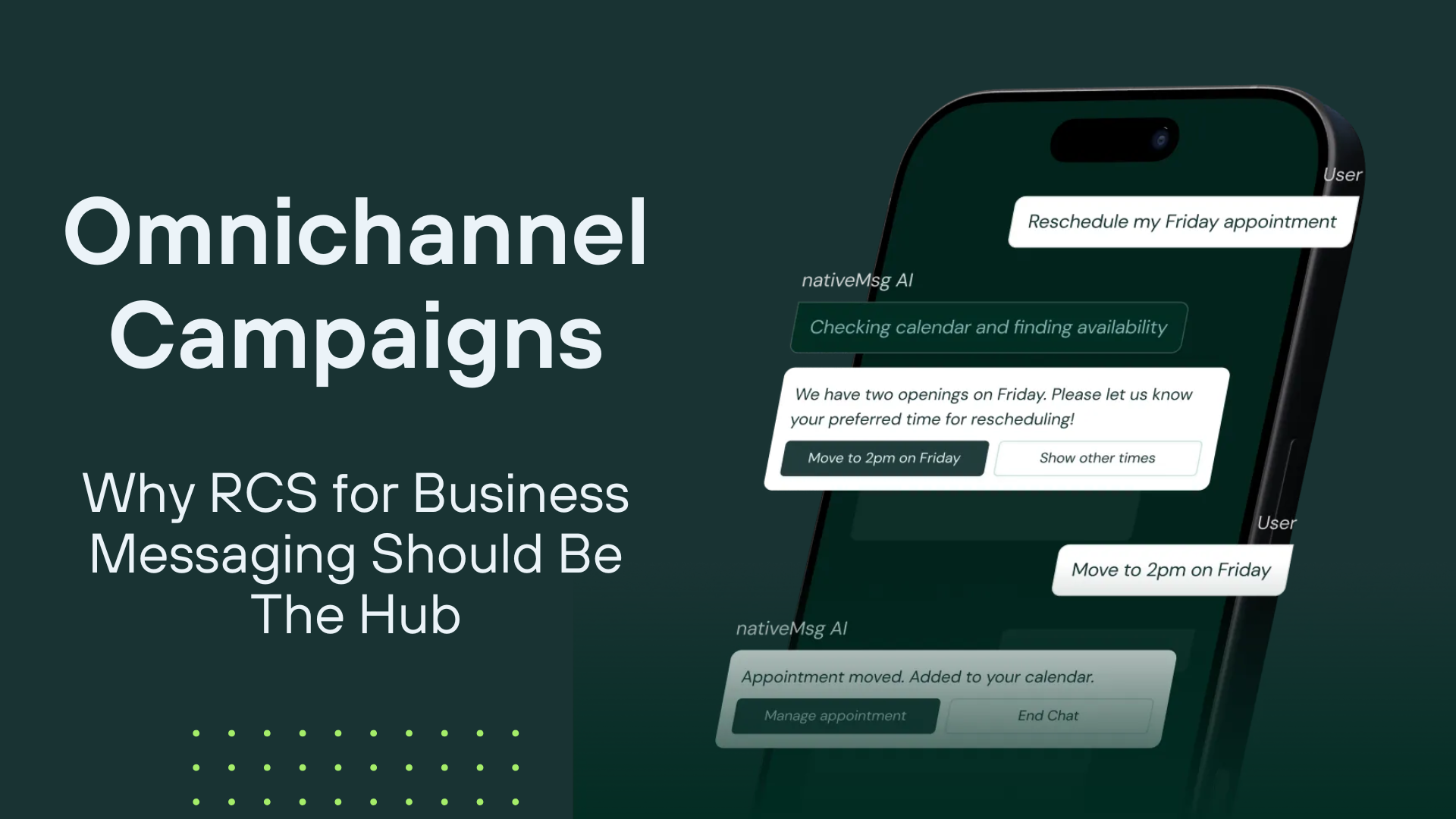
It’s a central engagement layer that connects them all. That’s where RCS omnichannel marketing changes the game. Not as a standalone channel, but as the hub that ties the entire customer journey together.
Omnichannel vs Multichannel: The Difference Actually Matters
The terms are often used interchangeably, but the distinction is critical. Let’s go over that first before we dive deeper:
Multichannel Marketing
- Multiple channels operate in parallel
- Each channel has its own goals, metrics, and logic
- Customers experience touchpoints separately
Multichannel asks: “How do we show up everywhere?”
Omnichannel Marketing
- Channels are connected and context-aware
- Actions in one channel influence the next
- The journey feels continuous, not repetitive
Omnichannel asks: “How do we guide someone forward?”
The problem? Most “omnichannel” strategies still rely on non-conversational channels (email, ads, push) to do the heavy lifting.
Where Traditional Omnichannel Usually Breaks Down
Even well-designed omnichannel programs struggle in three key areas:
1. Channels Don’t Talk in Real Time
Email opens are delayed, ad platforms are victims to algorithms and other outside factors, and app events are gated by logins and passwords. None of these channels are built for immediate, two-way interaction with your customers.
2. Journeys Are Designed for Systems, Not Humans
Customers are pushed through funnels instead of guided through conversations. The result is over-messaging, accidentally duplicated CTAs, and missed intent signals.
3. There’s No Natural Place to “Continue” the Journey
Clicking an ad sends users to a landing page. Emails send them elsewhere. Apps require installs. There’s rarely a single space where the journey can pause, resume, and adapt at the speed of your customers.
This is where messaging-led funnels outperform traditional designs.
Why Messaging Works as a Central Engagement Layer
Messaging is the most natural behavior on mobile, not just another marketing touchpoint. Think about it, people already:
- Text people to ask questions instead of Googling the answer
- Expect quick responses every time
- Continue conversations across time
A messaging-first marketing strategy aligns with how customers already behave instead of forcing them into channel-specific experiences that are easy to ignore.
What Messaging Does Better Than Any Other Channel
- Real-time, two-way interaction
- Persistent context across sessions
- High visibility without any new app installs
- Low friction progression from interest to action
Messaging becomes the place where intent is clarified, decisions are made, and journeys actually move forward.
RCS as the Bridge Between Email, Ads, and Apps
Now that we’ve discussed what component is missing in your omnichannel strategy, let’s talk about how nativeMsg’s RCS for Business customer journey design becomes powerful.
RCS (Rich Communication Services) combines:
- The reach of SMS ✅
- The richness of apps ✅
- The interactivity of conversational UX ✅
But its real value is how it connects channels, not replaces them.
RCS as a Journey Hub
Think of RCS as the connective tissue:
- Ads spark interest → RCS captures intent
- Email nurtures awareness → RCS converts engagement quickly
- Apps handle power users → RCS supports everyone else
Instead of having every channel try to convert, you can make handoffs to RCS experiences in order to continue the journey.
Real-World RCS Customer Journey Examples
We want to take a little bit of time to give you some examples of how the journey can flow effortlessly from one channel to another using RCS for Business messaging:
Example 1: Retail Re-Engagement
- Customer clicks a social ad
- Ad CTA launches an RCS experience directly to their messaging apps (Android or iOS)
- RCS carousel shows products that are currently in stock nearby
- The user taps to add the product to their cart, or ask a question about the product
- Follow-up messages adapt based on interaction (answer to their question, another button to add to cart/checkout)
No landing pages. No form fills. Just momentum and purchases in the palm of their hands.
Example 2: Financial Services Onboarding
- Welcome email introduces the product
- The CTA in the email opens an RCS experience instead of a static page
- RCS delivers a step-by-step guide in PDF or visual format
- The user can pause and resume later in the same thread if they need to
- Support and troubleshooting happen in the same chat, all without breaking the experience
- The user completes their training
This is customer journey orchestration, not channel hopping. Here’s one more example:
Example 3: Post-Purchase Support
- Transactional email confirms purchase
- RCS message offers delivery tracking and FAQs
- Buttons allow instant actions
- Issue resolution happens conversationally in the chat (either automated with AI or with an actual customer service representative)
- Satisfaction survey lives in the same thread, delivered whenever you want it to
The journey doesn’t reset, it evolves.
Designing Messaging-First Customer Experiences
To move from omnichannel theory to execution, brands need to design journeys around messaging, not bolt it on later. Here are some examples of how they work in tandem:
1. Use other channels to start conversations: ads and emails are great at discovery. Let RCS be your closer.
2. Keep context persistent: every interaction should remember what came before (preferences, actions, intent)
3. Design for continuation, not completion: RCS messaging allows journeys to pause and resume without friction.
4. Measure momentum, not just conversions: track replies, taps, and progression, not just end goals. You’ll clearly see how they got to the finish line.
Why RCS & Omnichannel Marketing Wins
Traditional omnichannel strategies focus on coverage. Messaging-first strategies focus on continuity. By positioning RCS as the hub:
- Journeys feel human, not mechanical
- Channels support each other instead of competing
- Customers stay engaged instead of bouncing
RCS isn’t just another channel in your stack. It’s the place where your omnichannel strategy finally becomes a connected experience.
Turn RCS Into the Hub of Your Omnichannel Strategy
To recap, omnichannel strategies don’t fail because brands lack channels, they fail because those channels don’t share a common conversation layer. nativeMsg helps brands make messaging the center of the customer journey.
With nativeMsg, you can:
- Launch RCS-powered experiences that connect ads, email, and apps
- Design messaging-first funnels that adapt in real time
- Orchestrate end-to-end customer experiences from a single platform
- Deliver rich, branded, interactive conversations at scale
Whether you’re modernizing an existing omnichannel strategy or building a new messaging-led strategy from the ground up, nativeMsg gives you the tools to turn fragmented touchpoints into connected customer journeys.
Ready to see what RCS omnichannel marketing looks like in action? Book a free, 30-minute demo and start designing customer experiences that actually move the needle forward.