
Table of Contents:
Somewhere in your stack, a system fires a message every time an order is confirmed, packed, shipped, or delivered, and you pay individually for all of them. Your customers open nearly all of them, because a delivery update is one of the few messages a person actually wants to see.
And then…nothing happens. The message is a receipt, not an invitation to do more.
That is the strangest line item in most marketing budgets: the messages with the best open rates in the entire program are the only ones nobody is asked to monetize. Until now.
The most-read message you own is doing the least work
Marketing teams spend months optimizing email subject lines to move an open rate from 21% to 24%. Meanwhile the shipping notification sitting next to it in the same customer relationship gets opened almost every time, and it carries a tracking link and nothing else.
The reason feels historical, and not really strategic. Transactional messages are scoped as notifications, so they were built as notifications: 160 characters, one link, no branding, no interaction. The channel constrained the ambition, and then the ambition never got revisited after the channel changed.
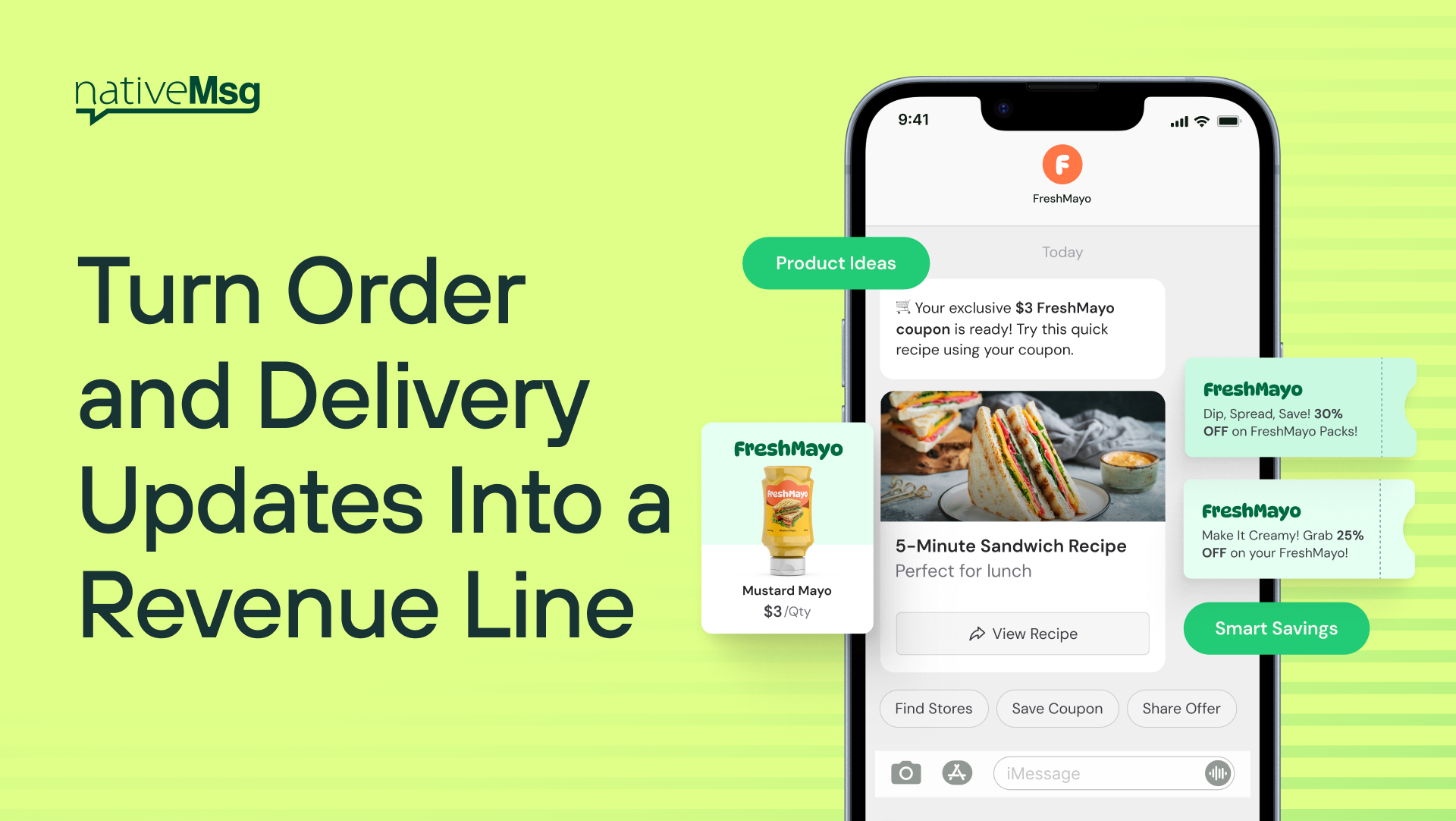
That entire system has now changed. Rich Communication Services, the new mobile carrier standard that replaces SMS on modern cell phones, lets that same triggered message carry your logo, a verified company name, a product image, a tracking card, quick replies, and action buttons. The same trigger responding to the same moment, but now with considerably more capability in the end result.
The trust problem is hiding in the same message
There is a second reason to look hard at these messages, and it is less comfortable.
Fake delivery notifications are among the most impersonated message categories in reported text-scam data, alongside bank impersonation. The FTC logged $470 million in reported text-scam losses in 2024 alone. Consumers have been trained (correctly) to distrust a tracking link that arrives from an anonymous number.
So your legitimate delivery update now competes with a fraud attempt that looks exactly like it. You pay full price for the message, and a share of your customers hesitate before tapping, or do not tap at all, or call support to ask whether it was really you. That hesitation is not a marketing problem you can write your way out of. It is a sender identity problem.
A carrier-verified sender fixes it structurally. Your brand name and logo appear in the thread, the sender is spoof-protected, and the customer can tell at a glance that the message came from you. The message that was hardest to trust becomes the easiest.
What the upgraded message looks like
For example, let’s say you’re sending out a notification that a package has been shipped. The current version is a line of text and a URL.
The upgraded version, from a verified sender, can carry:
- A tracking card with the order number, expected delivery window, and a button that opens live tracking without a browser detour
- The actual product image, so the customer knows which of their three open orders this is for
- Action buttons for the two things people always want next: change the delivery address, or contact support
- A quick reply that opens a two-way conversation instead of routing to a phone queue
- An image carousel with two or three contextually relevant items, positioned as a useful next step rather than an ad
That last element is where the revenue line appears. A customer who just learned their coffee order is arriving Thursday is in an unusually receptive moment for filters, a grinder, or a subscription for more coffee. One financial services brand reported a 45% rise in cross-sell opportunities after moving to interactive messaging. It’s all about placing relevant offers inside a message the customer opened voluntarily.
No new triggers = no new workflow
The reason this play closes faster than almost anything else in a lifecycle roadmap: there is nothing new to build on the trigger side.
Your commerce platform, order management system, or ERP already fires these events. If that system can send a webhook, call a REST API, or run an AI agent, it can start a branded conversation instead of a plain text. The trigger layer stays exactly as it is, but the delivery layer upgrades.
That is what makes this an expansion play rather than a project. You are not adding messages to the customer's life or a new tool to your stack. You’re changing what your existing messages are capable of.
What to measure in the first 30 days after upgrading
Run it as a split, not a rebuild. Take one message type, the shipping notification is usually the best candidate, and route half the traffic through the upgraded format and half through your current sender. Then compare four numbers:
- Tap-through on the primary action (tracking, address change). Expect a meaningful gap. Interactive formats typically run 45% or more above plain text on click-through.
- Support contacts per thousand messages sent. Verified branding and an in-thread support button both pull this down.
- Attributed revenue from the cross-sell element. This is the number that turns a cost line into a revenue line, and it is the one your CFO will ask about.
- Opt-out rate. Watch it. If a cross-sell is placed badly, this is where it shows up first, and it is easy to correct.
Thirty days of that split gives you your own data instead of a vendor's benchmark, which is the only evidence that survives an internal budget conversation.
Start with the message you already trust the most
There is a version of lifecycle strategy that involves a twelve-month roadmap and a new platform. This is not that. Pick the one triggered message your customers already open, upgrade what it can do, and measure it against the version you are sending today.
Our mantra is to “start small, prove it works, then scale.” We find that it works every time.
See it on the device it lands on
Don't take our word for it, tap through it yourself
The interactive guides walk you through a branded messaging experience exactly as your customer would see it, on the platform they are holding:
Ready to talk about your own triggered messages? Book a demo and we will map one message type you already send, show you the upgraded version, and set up the 30-day split so the result is your data, not our benchmark.