
Table of Contents:
Personalization isn’t new. For years, brands have used names in subject lines, recommended products in emails, and segmented audiences into increasingly granular groups. But today’s customers expect more than “Hi [First Name].” They expect experiences that feel:
- Timely
- Relevant
- Contextual
- Effortless
This is where hyper-personalization comes in and where most traditional channels (especially email) fall short.
To truly deliver hyper-personalization at scale, businesses need more than AI. They need the right delivery channel. That channel is RCS for Business (Rich Communication Services).
The Limits of Email Personalization
Email has been the default personalization channel for years. But it has inherent limitations:
- Low open rates and crowded inboxes
- Delayed engagement
- Static content (even when personalized)
- Limited interactivity
- Friction between message and action
Even with AI-generated content, email often remains a passive experience. It delivers information, but doesn’t drive immediate interaction.
What Hyper-Personalization Actually Requires
True hyper-personalization isn’t just about inserting dynamic content. It requires:
- Real-time data and decisioning
- Behavioral context
- Adaptive messaging
- Interactive experiences
- Immediate paths to action
In other words, personalization needs to be: dynamic, conversational, and actionable. This is where AI excels, but only if paired with a channel that can support it (like ours).
Why RCS Is Built for Hyper-Personalization
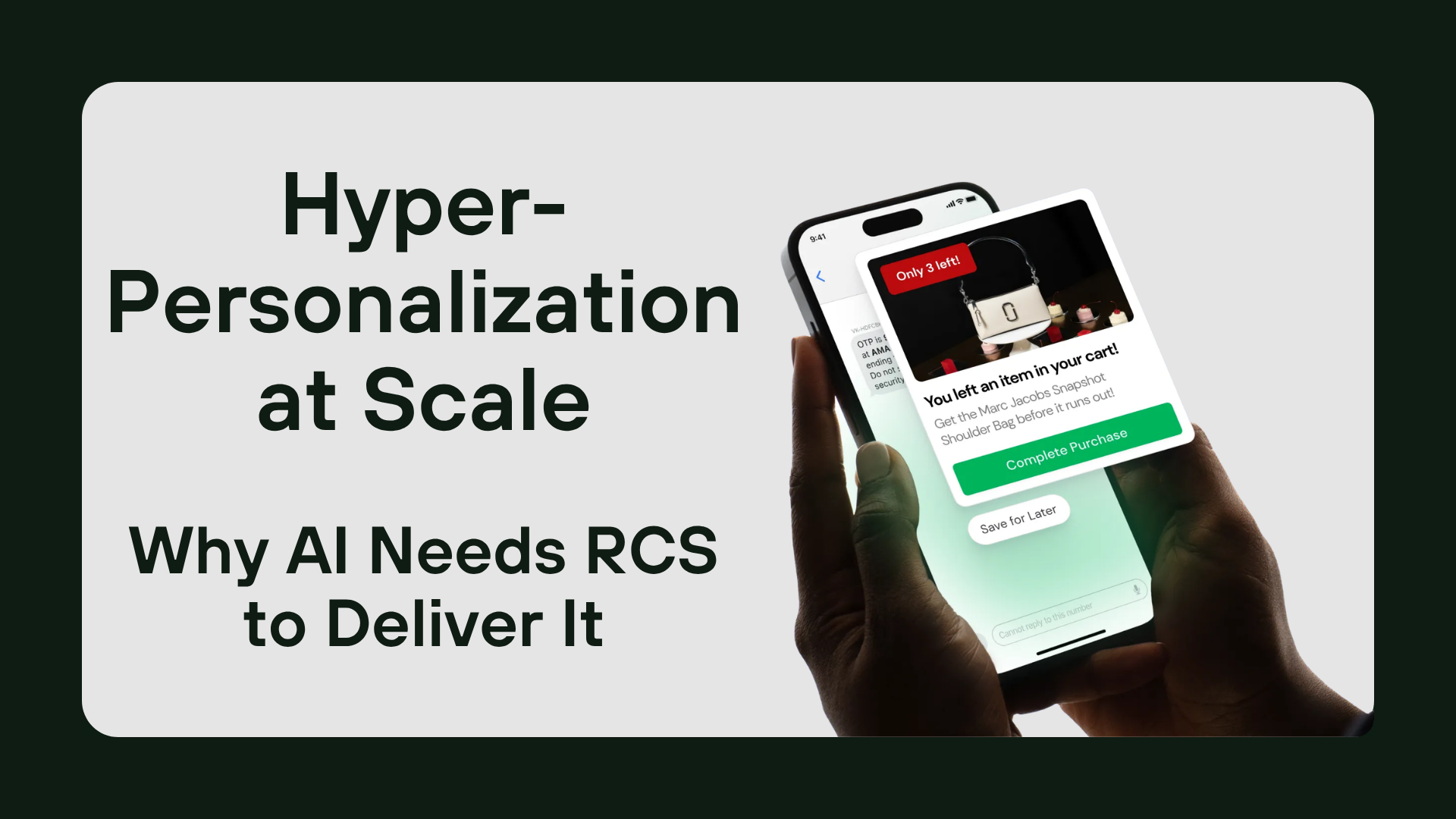
RCS transforms messaging into a rich, interactive experience inside the native messaging app. It enables:
- Visual content (images, carousels, videos)
- Suggested replies and action buttons
- Real-time, two-way conversations
- Persistent messaging threads
- Verified, branded interactions
When combined with AI, RCS becomes a delivery engine for real-time, individualized experiences.
5 Ways AI + RCS Enable Hyper-Personalization at Scale
1. Real-Time, Behavior-Driven Messaging
AI can analyze user behavior instantly (browsing patterns, purchase history, engagement signals, and more) and can trigger messages at the right moment. With RCS, those messages become:
- Context-aware
- Visually engaging
- Interactive
Instead of a delayed email, users receive a message when intent is highest.
Impact: Higher engagement and conversion rates.
2. Dynamic Content That Adapts in Conversation
Email personalization is static, while RCS allows AI to adapt in real time:
- Adjust recommendations based on responses
- Update offers dynamically
- Guide users through personalized flows
Every interaction refines the experience.
Impact: More relevant interactions and better outcomes.
3. Interactive Personalization
Hyper-personalization isn’t just about what you show, it’s about how users interact. RCS enables:
- Swipeable product carousels tailored to the user
- Button-based choices (preferences, sizes, options)
- Guided journeys based on selections
This turns personalization into a two-way experience.
Impact: Increased engagement and reduced friction.
4. Seamless Path to Action
One of the biggest gaps in email is the jump from message → website → action. RCS reduces that gap by enabling:
- One-tap actions
- Pre-filled responses
- Direct links to checkout or booking
AI can optimize each step based on user behavior.
Impact: Faster conversions and fewer drop-offs.
5. Continuous Learning and Optimization
The beauty of your AI model is that it doesn’t just personalize once, it learns continuously. With RCS, every interaction provides signals:
- What users click
- What they ignore
- How they respond
This data feeds back into future interactions, making personalization smarter over time.
Impact: Scalable personalization that improves with every touchpoint.
From Personalization to Individualization
The real shift here is moving from segment-based marketing to individual-level experiences.
- Go from “customers like you” to “you, specifically”
- Go from scheduled campaigns to real-time interactions
- Go from static messages to adaptive conversations
RCS enables AI to deliver this level of personalization in a way that feels natural because it happens in a familiar, everyday channel.
Why This Matters Now
Customers are no longer impressed by basic personalization. They expect:
- Immediate relevance
- Context-aware interactions
- Seamless experiences
At the same time, brands face:
- Rising competition for attention
- Declining email performance
- Increased pressure to improve ROI
AI + RCS solves both sides of this equation.
Final Thoughts
Hyper-personalization isn’t just about better data or smarter AI.
It’s about delivering the right experience — at the right time — in the right place.
Email helped define the first era of personalization.
RCS is defining the next.
Brands that embrace this shift will move beyond messaging at scale — and start delivering experiences at scale.
See It For Yourself
If you're looking to move beyond email and deliver true hyper-personalization at scale, the combination of AI and RCS is a powerful place to start.
At nativeMsg, we help brands create AI-driven RCS experiences that adapt in real time, engage customers directly, and drive measurable results. You can book a free demo to see it in action.