
Table of Contents:
HR Communication Is Falling Behind Employee Expectations
HR teams are responsible for some of the most important moments in the employee lifecycle. These moments include recruiting, onboarding, benefits enrollment, and ongoing communication. Despite the importance of these functions, many of these interactions still rely on outdated tools like email threads, static portals, and one-way notifications.
The result?
- Missed messages or slow response times
- Candidate drop-off
- Employee frustration
As employee expectations shift toward faster, more conversational experiences, we’ve learned that HR teams are now rethinking how they communicate. Increasingly, they’re turning to RCS (Rich Communication Services) for Business to modernize HR engagement, all without requiring new apps or logins. Let’s get into some issues HR teams are facing, and then talk about some ways that RCS can makes things better.
Why Traditional HR Channels Fall Short
Most HR communication stacks weren’t designed for immediacy or interaction.
Email Is Easy to Ignore
Inbox overload means critical messages get buried, especially during onboarding periods. Follow-ups are manual, and engagement is difficult to track in real time.
Portals Create Friction
HR systems and portals require logins, passwords, and proactive effort from employees, adding layers of friction to new or transitioning employees.
SMS Is Limited
While SMS has reach, it lacks branding, interactivity, and structured workflows, which are all essential for HR use cases. HR teams need a dedicated communication channel that’s accessible, interactive, and trusted. That’s where RCS stands out and shines.
What Makes RCS Different for HR Teams
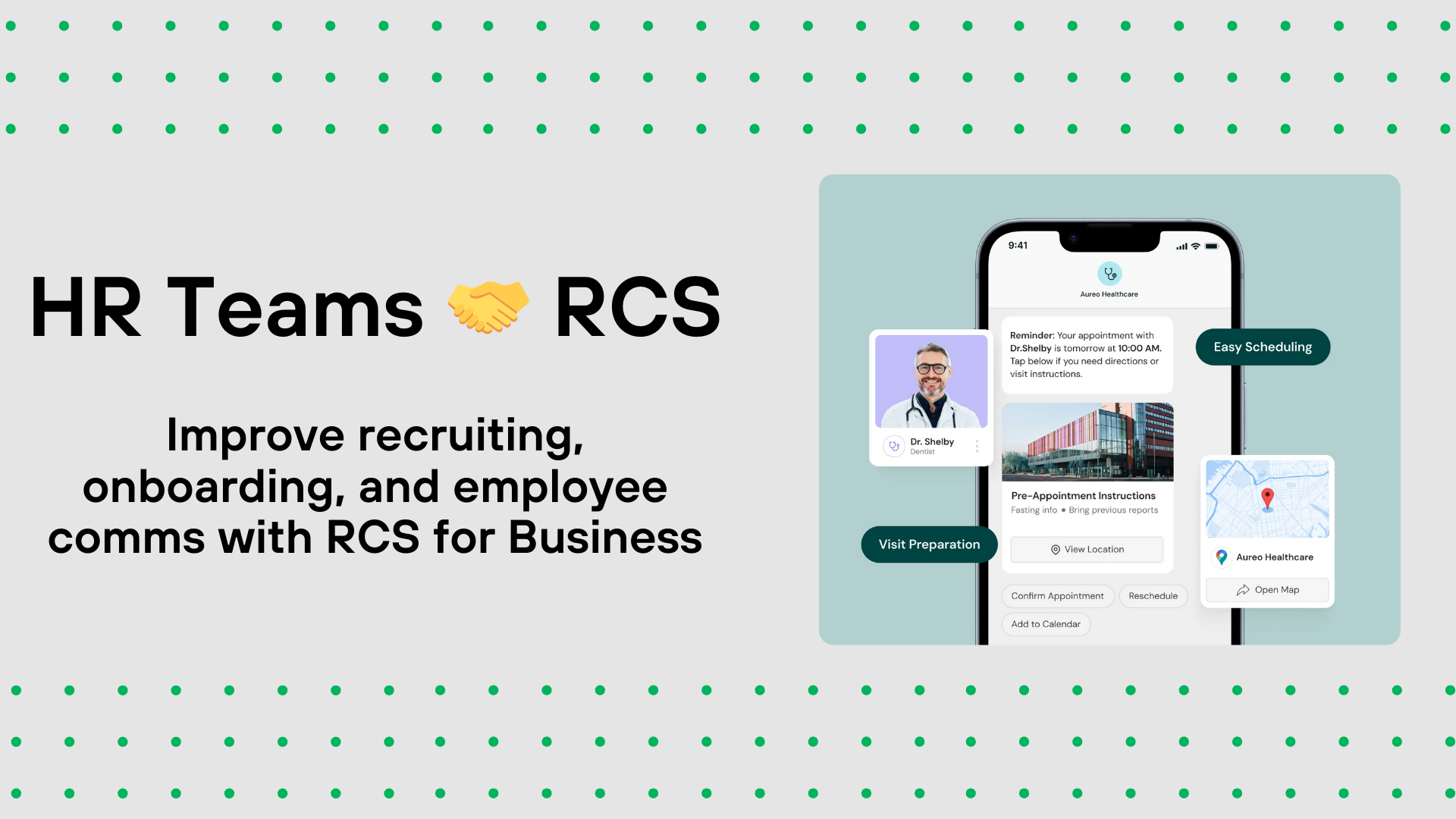
RCS brings app-like experiences directly into a user’s native messaging inbox. With RCS, HR teams can send:
- Branded messages that build trust
- Rich cards, carousels, and images
- Buttons for quick actions (confirm, reschedule, acknowledge)
- Secure two-way conversations that employees can pick up and resume at any time
All without asking candidates or employees to download anything. This makes RCS ideal for time-sensitive, high-importance HR communication.
Key Ways HR Teams Use RCS to Their Advantage
1. Recruiting and Candidate Engagement
In 2026, recruiting moves fast and candidates expect quick, clear communication. RCS helps HR teams:
- Send interview invites with confirm/reschedule buttons, all tied to your calendar
- Share job details, locations, and timelines visually
- Answer candidate questions in real time (either with live chat support or AI automations)
- Reduce no-shows and drop-off
Instead of juggling emails and calls, recruiters can manage conversations in one persistent and trackable thread.
2. Interview Scheduling and Reminders
Missed interviews cost time and momentum. With RCS, HR teams can:
- Send and automate interview invites and reminders with confirm/reschedule buttons, all tied to your calendar
- Allow instant confirmations or reschedules
- Share directions or virtual meeting links
- Send last-minute updates without clutter
The end result is smoother scheduling and an overall better candidate experience.
3. Onboarding New Hires
Onboarding is where engagement either sticks or slips. RCS can provide:
- Step-by-step onboarding checklists
- Document reminders and acknowledgments
- Day-one instructions and FAQs
- Two-way support during the first weeks
Because the conversations persist, new hires can come back to the same thread whenever they need guidance.
4. Internal HR Communication and Updates
From policy changes to benefits enrollment, internal communication is often overlooked until it’s urgent. RCS allows HR teams to:
- Send high-visibility announcements
- Include clear CTAs (review, acknowledge, enroll)
- Answer employee questions conversationally
- Reach deskless and frontline workers reliably
This reduces confusion and increases participation in critical programs.
5. Benefits and Time-Sensitive HR Actions
Lastly, enrollment windows, deadlines, and compliance updates demand attention. RCS supports these functions by providing:
- Visual explanations of benefits options
- Reminders with one-tap actions
- Confirmation of completed steps
- Reduced follow-up workloads for HR teams
Instead of chasing responses, HR teams can guide employees forward in real time.
Why Messaging Works Across the Employee Lifecycle
HR journeys aren’t linear. They pause, resume, and evolve at different times, and that’s okay. Messaging supports our reality better than any other channel because:
- Conversations persist over time
- Context isn’t lost between interactions
- Employees and candidates respond when it’s convenient
- Engagement feels human and not transactional
This is why HR teams are increasingly adopting messaging-first communication strategies with RCS at the center of it all.
How nativeMsg Powers RCS for HR Teams
RCS for Business is a powerful tool, but only when it’s deployed thoughtfully. At nativeMsg, we help HR teams turn RCS into a scalable, secure communication layer all the time. To recap, with nativeMsg, HR teams can:
- Launch RCS conversations across recruiting and employee communications
- Deliver branded, interactive experiences at scale
- Orchestrate messaging alongside email and other channels
- Maintain consistent experiences across the employee journey
- Measure engagement beyond opens and clicks
From candidate outreach to internal HR workflows, nativeMsg can enable HR teams to communicate faster, smarter, and more effectively.
Modern HR Communication Starts With RCS
In closing, HR teams don’t need more tools, they need better conversations. By using RCS as a central engagement channel, HR leaders can improve response rates, reduce friction across key moments, strengthen trust with candidates and employees, and modernize communication without increasing complexity.
But don’t take our word for it. Do you want to see how HR teams use RCS in the real-world? Book a free, 30-minute demo and discover first hand how messaging experiences will create better outcomes across your entire employee lifecycle.