
Table of Contents:
AI agents are quickly moving from concept to reality. These systems don’t just generate text, they take action. They can book appointments, reorder products, resolve issues, and coordinate workflows on behalf of users. But as powerful as they are, most AI agents face a critical limitation:
They don’t have a native interface for real-world interaction.
That’s where RCS for Business (Rich Communication Services) comes in.
RCS provides the missing layer — a direct, interactive, and scalable interface that allows AI agents to operate seamlessly within the customer’s everyday communication channel: messaging.
The Interface Problem with AI Agents
AI agents are designed to execute tasks, but execution requires interaction. Today, most agents rely on:
- Web apps or dashboards
- Chatbot widgets
- API-driven backend actions
- Voice assistants
These interfaces create friction:
- Users must open an app or website
- Engagement is inconsistent
- Context is often lost between sessions
- Actions feel disconnected from communication
In short, agents can act but not always where and (most importantly) when it matters most.
Why Interfaces Matter for Agentic Workflows
For AI agents to deliver real value, they need to:
- Communicate clearly
- Confirm intent
- Present options
- Trigger actions instantly
- Maintain context over time
This requires more than a backend system, it requires a persistent, interactive interface embedded in the user’s daily behavior.
Our messaging platform is that interface.
What Makes RCS Ideal for AI Agents
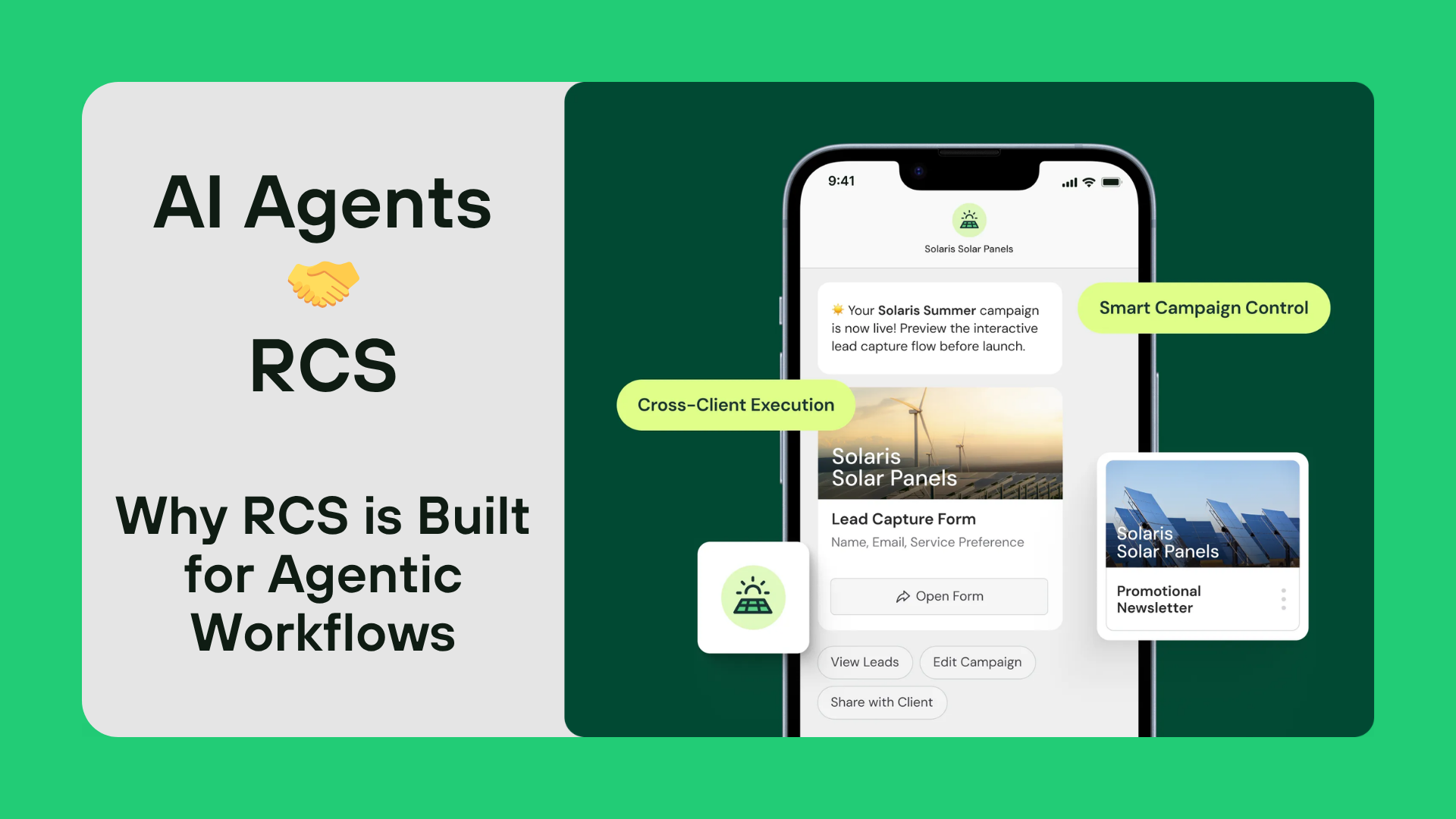
RCS transforms messaging into a dynamic, app-like environment without requiring downloads or logins. It enables:
- Rich cards, carousels, and media
- Suggested replies and action buttons
- Real-time updates and confirmations
- Verified, branded interactions
- Two-way conversational flows
For AI agents, this means they can both communicate and execute within the same channel.
5 Ways RCS Powers Agentic Workflows
1. Triggering Actions in Real Time
AI agents can initiate actions directly through RCS messages:
- “Your prescription is ready — reorder now?”
- “Your subscription is expiring — renew in one tap”
- “Your flight changed — select a new option below”
With interactive buttons, users can approve or modify actions instantly.
Result: Faster decisions and reduced friction.
2. Closing the Loop with Confirmations
Execution isn’t complete until the user is informed. RCS allows agents to:
- Confirm completed actions
- Provide status updates
- Share receipts or summaries
- Offer next steps
All within the same thread.
Result: Increased trust and transparency.
3. Maintaining Context Across Interactions
Unlike fragmented channels, RCS keeps conversations persistent. AI agents can:
- Reference past interactions
- Continue workflows over time
- Adapt based on user behavior
This turns isolated actions into ongoing relationships.
Result: More cohesive and personalized experiences.
4. Presenting Structured Choices
Agentic workflows often require decisions. RCS enables:
- Button-based responses
- Multi-option selections
- Visual comparisons (e.g., plans, products)
This reduces ambiguity and cognitive load.
Result: Higher completion rates for complex tasks.
5. Blending Automation with Human Handoff
Not every workflow should be fully automated. With RCS, AI agents can:
- Handle routine actions
- Escalate to human agents when needed
- Pass full context during handoff
Result: Efficiency without sacrificing experience.
From Chatbots to Agents: What Changes
The shift to agentic AI is not just about smarter models, it’s about execution at a high, strategic level. RCS enables that shift by turning messaging into:
- A command surface
- A decision interface
- A transaction layer
Instead of asking users to navigate systems, AI agents bring the system to the user.
Why This Matters Now
As AI agents become more capable, expectations will rise. Users won’t just want answers, they’ll expect outcomes. That means:
- Fewer steps
- Faster actions
- More intuitive interactions
RCS meets these expectations by embedding agent capabilities into a familiar, high-engagement channel.
Final Thoughts
In closing, your AI agents are only as effective as their ability to act.
RCS provides the interface that makes those actions seamless, contextual, and scalable. Together, they unlock a new model of engagement where conversations don’t just inform decisions, they drive them.
The future of AI isn’t just conversational. It’s agentic, interactive, and embedded in the channels people use every day.
See It For Yourself
If you're exploring how to deploy AI agents that can actually execute workflows, the interface matters more than you might think.
Here at nativeMsg, we help brands power agentic experiences through RCS, enabling AI to trigger actions, guide decisions, and complete tasks directly within messaging. Book a demo to check it out in real-time.