
Table of Contents:
Unlike most numbers in marketing, this one is not an estimate. Log into your commerce platform right now and you can see exactly how much revenue walked out of checkout last month, itemized, with the products attached.
Which is why cart recovery is the easiest budget conversation in the building. Nobody has to be convinced the loss is real, the only open question is whether your recovery attempt is any good.
For most teams, it isn’t. Not because the copy is weak, but because of where the message sends the customer next.
Your recovery message is asking for too much
Look at what a standard recovery sequence actually requires of someone. You open an email that landed in a promotions tab, tap a link, wait for your browser to load, land on a site that hopefully remembers the cart, sign in, re-enter a payment method, then FINALLY complete a checkout.
Feels like a lot to ask, doesn't it? Every one of those steps is a place to lose them, and you are asking a person who has already demonstrated hesitation to walk through all of them.
Make the recovery a tap, not a trip
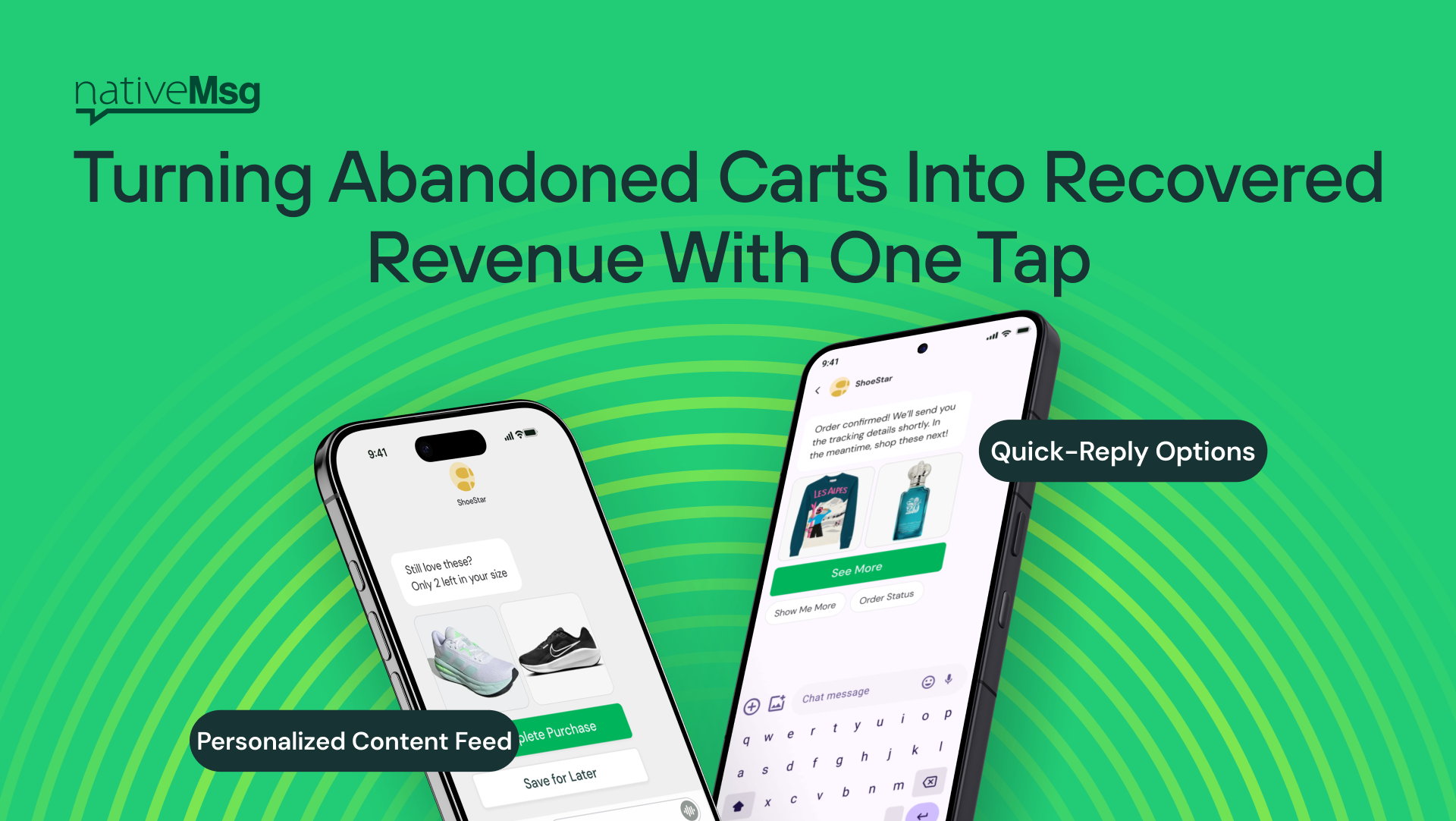
Rich Communication Services, the mobile carrier standard that has replaced SMS on modern devices, changes what that triggered message is able to carry. Instead of a line of text and a link, the cart-abandon event can fire a conversation that includes:
- The actual product the customer left behind, with its image, variant, and price, so recognition is instant and there is no ambiguity about which cart this is
- A one-tap action button that returns them to a live checkout with the cart intact
- A quick reply for the question that caused the hesitation in the first place: shipping timing, return policy, sizing, stock
- A two-way thread so that question gets answered by a conversational flow or a person, in the same place, without a support ticket or a phone queue
- An image carousel of two or three alternates when the original item is the problem rather than the purchase intent
Notice what the quick reply does to your discount habit. A meaningful share of abandoned carts are not price objections at all, they are unanswered questions. When the customer can ask and get an answer inside the message, you recover the sale at full margin. The discount becomes a tool you choose rather than a reflex.
The results in-market follow that logic. Interactive cart messages have been reported converting at three to seven times the click-through of plain text equivalents, and one large retailer measured an 8% lift in orders and a 17% increase in revenue after moving payment and recovery offers into interactive messaging.
Your sender identity is doing the quiet work here
There is one more reason our RCS format outperforms, and it has nothing to do with the buttons.
A cart recovery message is functionally a payment request with a link, which is precisely the message type consumers have learned to distrust. Fraudulent order and delivery notifications are among the most impersonated categories in reported text-scam data.
A carrier-verified sender puts your brand name and logo in the thread and protects the number from spoofing. The customer can immediately tell that the message is yours. That single fact is often the difference between a tap and a deletion, and no amount of copywriting substitutes for it.
The trigger already exists
This is an upgrade to an existing workflow rather than a new program.
Your commerce platform already emits a cart-abandon event, and your marketing automation already listens for it. If that system can send a webhook, call a REST API, or run an AI agent, it can start a branded conversation instead of sending a plain text. The trigger layer stays untouched. Automatic SMS fallback covers any device that cannot receive the upgraded format, so no segment of your list goes dark during the transition.
Practically, that means the first version of this can be live in weeks, running alongside the sequence you have today rather than replacing it.
What to measure in the first 30 days
Split the traffic. Route half your cart-abandon events through the upgraded format, leave half on your current sequence, then compare:
- Recovered revenue per thousand messages sent. The headline number, and the one your finance team will use.
- Tap-to-checkout rate against your email and text baselines. This is where the three-to-seven-times figures either show up in your own data or they do not.
- Discount dependency. What percentage of recoveries required a code? If the conversational version recovers carts at full price, that margin difference is often larger than the volume difference.
- Time to recovery. Faster recoveries tend to mean fewer competitive comparison windows.
- Opt-out rate. Watch it closely in week one. A recovery message is welcome; three of them are not.
Thirty days of that split produces your own numbers, which is the only evidence that holds up in a budget review.
Start with one flow
You do not need a lifecycle replatform to test this. Take the single highest-value cart-abandon trigger you already run, upgrade what the message can do, and measure it against the version you are sending today.
Start small. Prove it works. Then scale.
See it on the device it lands on
Don't take our word for it. Tap through it.
The interactive guides walk you through a branded messaging experience exactly as your customer would see it, on the platform they are holding:
Want to see it with your own catalog? Book a demo and we will build the recovery flow for one of your products, show you what the customer would see, and set up the 30-day split so the result is your data rather than our benchmark.