Table of Contents:
Choosing the right marketing channel has never been more complicated.
Brands today have more options than ever — email, SMS, push notifications, paid ads, in-app messaging, and now RCS for Business (Rich Communication Services). Each channel has its strengths, but they aren’t built for the same purpose. The challenge isn’t picking one. It’s knowing which channel to use, when, and why.
In this post, we’ll break down how RCS compares to other marketing channels and how to choose the best one for each pillar in your channel strategy. Let's get started.
Why Channel Strategy Matters More Than Ever
Customer expectations are rising, while attention is fragmented. That means:
- The wrong channel = ignored message
- The wrong timing = missed opportunity
- The wrong experience = lost conversion
The best-performing brands don’t rely on a single channel, they orchestrate multiple channels strategically.
RCS Compared to Other Marketing Channels
Let’s start with a quick breakdown of how RCS stacks up.
RCS vs SMS
SMS
- Pros: Universal reach, simple, reliable
- Cons: Limited to text, low interactivity
RCS
- Pros: Rich media, buttons, carousels, branded experience
- Cons: Requires supported devices/networks
Best use:
- SMS → urgent, simple alerts (e.g., OTPs)
- RCS → interactive experiences (shopping, support, engagement)
RCS vs Email
- Pros: Detailed content, long-form communication
- Cons: Low open rates, delayed engagement
RCS
- Pros: High visibility, real-time interaction, mobile-native
- Cons: Not ideal for long-form content
Best use:
- Email → newsletters, detailed updates
- RCS → timely, action-driven messaging
RCS vs Push Notifications
Push Notifications
- Pros: Instant, app-based engagement
- Cons: Requires app install, easy to ignore
RCS
- Pros: No app required, richer interaction, persistent thread
- Cons: Slightly less instant than push in some cases
Best use:
- Push → app engagement
- RCS → broader reach + deeper interaction
RCS vs Paid Ads
Paid Ads
- Pros: Scalable reach, strong for acquisition
- Cons: Expensive, one-time interaction
RCS
- Pros: Owned channel, ongoing engagement, high conversion potential
- Cons: Requires opt-in
Best use:
- Ads → acquire users
- RCS → convert and retain them
RCS Is the Best Marketing Channel for Mobile
RCS stands out when you need:
- High engagement (messages seen and acted on quickly)
- Interactivity (buttons, replies, selections)
- Real-time communication
- Seamless path to action
- Conversational experiences
If your goal is to drive action and not just deliver information, then RCS is often the best mobile channel for you.
5 High-Impact RCS Use Cases
1. Abandoned Cart Recovery
You’ll be able to send interactive reminders with:
- Product images
- “Complete Purchase” buttons
- Personalized offers
Why RCS wins: Awesome visuals and product images + actionable buttons = higher recovery rates.
2. Conversational Commerce
You’ll allow your audiences to:
- Browse products
- Ask questions
- Make decisions
All within a message thread.
Why RCS wins: Reduces friction between discovery and purchase.
3. Customer Support
You’ll provide:
- Instant answers
- Order tracking
- Guided troubleshooting
With AI and human handoff.
Why RCS wins: Combines automation with a better user experience.
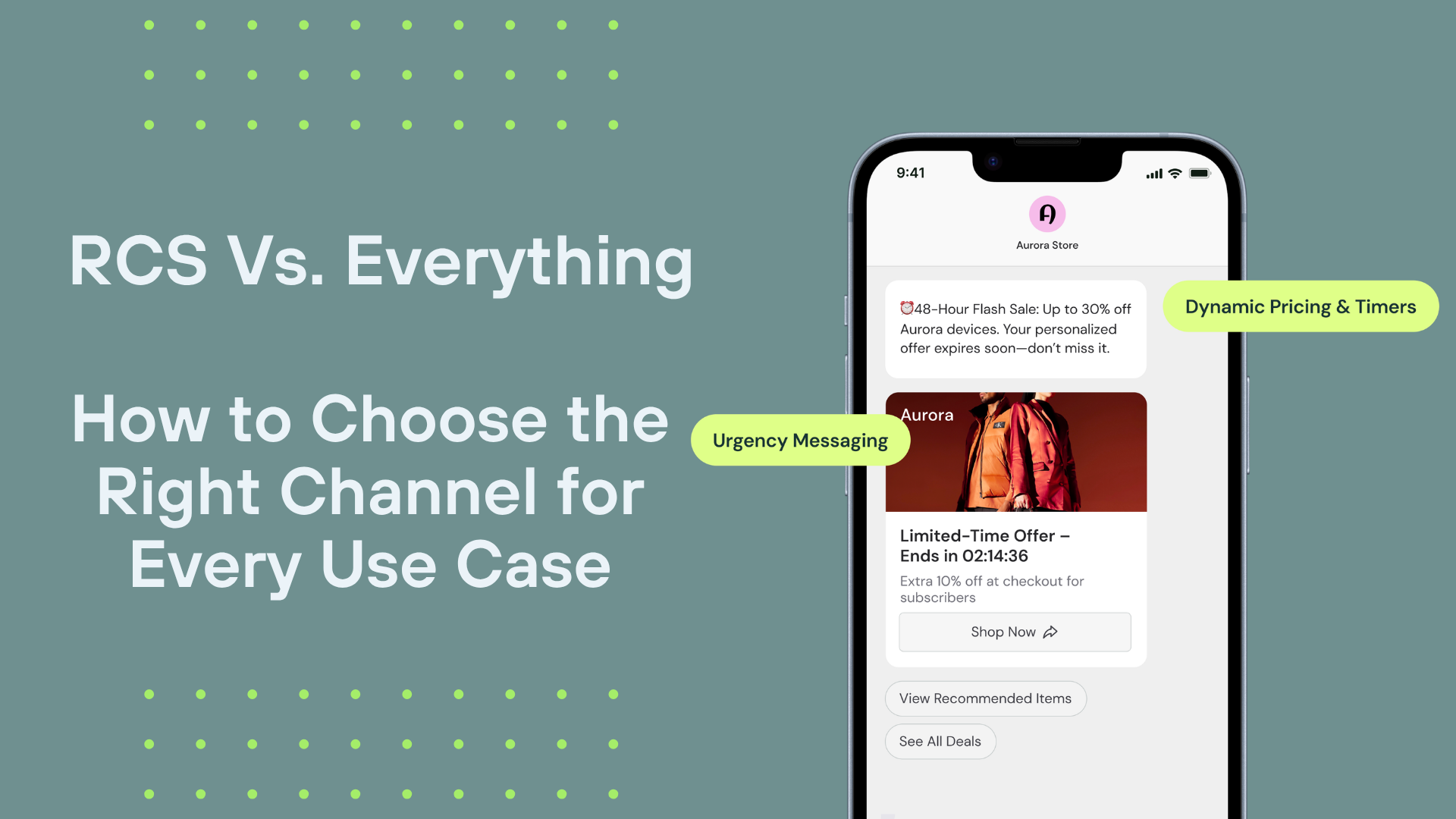
4. Promotions and Campaigns
You’ll deliver:
- Rich media offers
- Limited-time deals
- Personalized recommendations
Why RCS wins: Higher engagement than email or SMS.
5. Post-Purchase Engagement
You’ll keep customers engaged with:
- Updates and confirmations
- Upsell/cross-sell recommendations
- Loyalty messaging
Why RCS wins: Maintains a persistent, branded relationship.
Choosing the Right Channel for Each Use Case
The key isn’t replacing channels, it’s aligning them with intent. Here’s our channel strategy that we’ve seen clients implement and find great success:
Use Email when:
- You need depth and detail
- The message isn’t time-sensitive
Use Push when:
- You want to drive app engagement
Use Paid Ads when:
- You’re acquiring new users
Use RCS when:
- You want interaction, engagement, and conversion
- You’re guiding users through decisions
- You’re building ongoing relationships
The Real Strategy: Channel Orchestration
The best strategies combine channels:
- Ads → drive traffic
- RCS → engage and convert
- Email → follow up with detail
- SMS → handle critical alerts
RCS often becomes the bridge between acquisition and conversions where engagement actually happens.
Why This Matters Now
As privacy changes limit tracking and acquisition costs rise, brands need:
- More efficient conversion paths
- Stronger first-party relationships
- Higher engagement channels
RCS delivers all three, making it a key part of the modern marketing stack.
Final Thoughts
There’s no single “best” marketing channel, only the right channel for the right moment. But as mobile becomes the primary touchpoint, channels that are interactive and conversational will outperform those that aren’t every time.
RCS isn’t just another option, it’s quickly becoming a core channel for modern mobile engagement.
Check Out RCS
If you're evaluating which channels to invest in or how to better connect them, RCS for Business is worth a closer look.
nativeMsg helps brands integrate RCS into their broader marketing strategy, enabling more engaging, interactive, and conversion-driven experiences. Book a free, 30-minute demo to see it in a live environment and discover the power of RCS messaging for yourself.