
Table of Contents:
For years, SMS has been a reliable messaging channel but when it comes to analytics, it has always fallen short. Marketers were forced to rely on delivery receipts, link clicks, and assumptions about opens.
With RCS (Rich Communication Services), brands gain access to a new generation of messaging insights. RCS analytics provide visibility into user behavior that SMS tracking simply can’t match, helping teams optimize campaigns, prove ROI, and create better customer experiences.
This post breaks down what brands should measure with RCS analytics, and why it’s a major upgrade over SMS.
Why Analytics Matter More Than Ever in Messaging
As messaging becomes a primary customer touchpoint (we predict it will), brands are under pressure to answer key questions:
- Did customers actually read the message?
- Which content drove engagement?
- Where are users dropping off?
- What messaging formats convert best?
SMS struggles to answer these questions. RCS analytics, by contrast, are built for performance measurement from the ground up.
The Limits of SMS Tracking
Before exploring RCS analytics, it’s important to understand what SMS can’t do. Traditional SMS tracking is limited to:
- Message sent and delivered status
- URL click-through rates (via shortened links)
- Opt-outs
- Call measurement
So what’s missing?
- No true read receipts
- No insight into content engagement
- No visibility into message interactions
- No way to measure UX performance
This leaves marketers guessing, and guessing doesn’t scale.
What Makes RCS Analytics Different
RCS transforms messages from static text into interactive experiences, and the analytics match that shift.
With RCS analytics, brands can now accurately measure:
- Message delivery and reads
- Engagement with buttons and suggested replies
- Interaction paths within a single message
- Rich media performance (images, carousels, videos)
Instead of treating messages as notifications, RCS treats them as measurable experiences.
Core RCS Analytics Metrics Every Brand Should Track
1. Read Receipts (Actual Opens)
One of the biggest advantages of RCS analytics is read receipts. Unlike SMS, where opens are estimated, RCS tells you:
- Whether the message was delivered
- Whether it was opened
- When it was read
This enables accurate engagement reporting and cleaner attribution models, broken down at the campaign and individual levels.
Why it matters:
Brands can finally distinguish between messages that were ignored and messages that were truly seen.
2. Button Clicks and Suggested Reply Engagement
RCS replaces links with buttons and quick replies, and each interaction is trackable.
You can measure:
- Button click-through rates
- Which CTAs perform best
- Drop-off between message steps
Why it matters:
Instead of optimizing copy blindly, RCS analytics let you optimize actions.
3. Rich Media Performance
RCS supports images, GIFs, videos, and carousels with analytics to show how users interact with them. Trackable metrics include:
- Media impressions
- Engagement with rich cards or images
- Conversion rates tied to visual content
Why it matters:
Brands can identify which creative assets actually drive results, not just clicks.
4. Conversation Flow Analytics
RCS enables multi-step conversations inside a single thread. With RCS analytics, brands can pinpoint:
- User paths through a conversation
- The most-selected replies and actions taken afterward
- Abandonment points
Why it matters:
This turns messaging into a measurable funnel, not a one-way blast.
5. Conversion Attribution Inside Messaging
Because interactions happen natively (without forcing users to external links,) RCS analytics provide cleaner attribution. You can connect:
- Message interactions to purchases
- Button taps to form completions
- Replies to support resolutions
Why it matters:
RCS reduces attribution loss caused by browser handoffs and cookie restrictions by keeping everything within the messaging app.
Why RCS Analytics Beat SMS Tracking Every Time
Here’s a simple comparison:
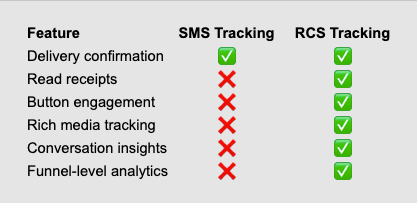
SMS tells you if a message was sent, RCS analytics tell you what users actually did.
How Better Analytics Lead to Better Customer Experiences
RCS analytics aren’t just about reporting, they directly improve UX. Brands can:
- Reduce message volume by replacing multi-SMS flows with one interactive RCS message
- Personalize content based on interaction history
- Optimize send timing using read behavior
- Design messages users actually want to engage with
To make it simple, better analytics lead to smarter and easier messaging decisions, creating less noise and more relevance for your brand.
Preparing Your Team to Use RCS Analytics Effectively
To get the most from RCS analytics, brands should:
- Align marketing, product, and analytics teams on KPIs
- Define success metrics beyond clicks (engagement depth, completion rate, conversions)
- Compare RCS vs. SMS performance during rollout
- Iterate creative and conversation design based on real data
RCS isn’t just a new channel, it’s a new measurement standard.
Final Thoughts: Analytics Are the Real RCS Advantage
While rich visuals and branded messages often get the spotlight, we believe RCS analytics are the true game-changer. Compared to SMS tracking, RCS analytics don’t just improve reporting, they transform how messaging drives business outcomes. Schedule a demo and learn more about how to take your marketing analytics to the next level.